
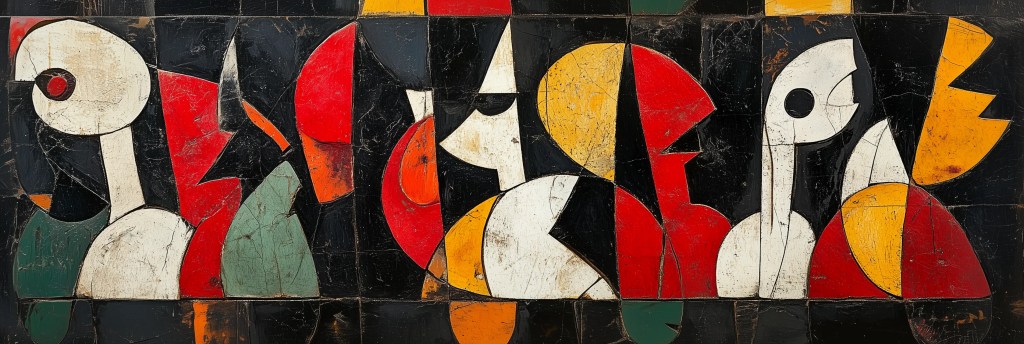
Dadaism: Deconstructed
What happens when art defies its very definition? When creation becomes a protest, and meaning dissolves into absurdity? Dadaism was born out of these questions, emerging like a whirlwind in the midst of World War I. A chaotic rebellion against the horrors of war and the conventional art world, Dada threw all expectations aside, creating space for the bizarre, the nonsensical, and the provocative. As you journey through the history, principles, and key figures of this radical movement, prepare to question not only art, but reality itself.
History of Dadaism
Dadaism emerged in 1916, during the turmoil of World War I, as a reaction against the horrors and irrationality of the conflict. It began in Zurich, Switzerland, at the Cabaret Voltaire, a gathering place for artists and intellectuals. Fueled by disillusionment with nationalism, war, and the bourgeois values that many blamed for the conflict, Dada artists sought to challenge traditional notions of art and culture. The movement quickly spread to Berlin, Paris, and New York, each developing its own flavor of Dada while maintaining its core ethos of absurdity, randomness, and protest. Through performance, poetry, and visual art, Dadaists aimed to dismantle the very concept of art, often using shock and satire to critique society.

Definition of Dadaism
Dadaism is a radical art movement that emerged as a reaction to the chaos and destruction of World War I, seeking to dismantle conventional art and logic. At its core, Dadaism rejects reason, logic, and traditional aesthetics, favoring instead absurdity, randomness, and spontaneity. It was a direct response to the belief that rational thought had led to the horrors of the war, so the Dadaists aimed to create art that defied explanation and embraced chaos. This movement produced artworks that questioned the very nature of art itself, often incorporating chance, found objects, and nonsensical elements to disrupt artistic norms.
The movement was characterized by experimental approaches, such as collage, photomontage, assemblage, and the use of “readymades”—ordinary objects repurposed as art. Dadaists sought to provoke their audience by breaking down the distinction between high art and everyday life, ultimately leaving viewers to question not only the artwork but the systems of meaning and culture that underpin it. In this way, Dadaism is not just an aesthetic, but a philosophical rejection of the established order.

Subgenres of Dadaism
Berlin Dada: This subgenre emerged as one of the most politically charged versions of Dadaism. It was deeply influenced by the post-war social and political unrest in Germany, often incorporating biting satire to critique authority, militarism, and capitalism. Artists in this subgenre, like John Heartfield and George Grosz, used photomontage to create powerful anti-war and anti-establishment messages..
Paris Dada: Paris became the hub of Dada after World War I, where the movement evolved into a more intellectual and experimental approach. While still absurdist, it leaned towards surrealism and a more poetic form of chaos. Artists like André Breton and Francis Picabia helped bridge the gap between Dadaism and the emerging Surrealist movement, focusing on psychoanalysis and dreamlike expression.
New York Dada: This version of Dada was more urban and avant-garde, with a focus on challenging the boundaries between art and everyday objects. Marcel Duchamp’s famous “readymades,” such as Fountain (a repurposed urinal), encapsulate New York Dada’s spirit. The city’s industrial backdrop and innovative spirit helped shape this subgenre into one that merged art with daily urban life, questioning the very idea of art creation.
Major Artists and Their Contributions
Marcel Duchamp
Duchamp is often considered the father of conceptual art and one of the most influential figures in Dadaism. His groundbreaking work with “readymades” challenged the boundaries of what could be considered art.
- His most famous work, Fountain (1917), a signed urinal, shocked the art world by redefining everyday objects as art.
- Duchamp’s emphasis on ideas over visual form laid the groundwork for future avant-garde movements, including conceptual art.
- His contributions blurred the lines between art, philosophy, and society, emphasizing the role of the artist’s intent.

Hannah Höch
A pioneering female figure in Dadaism, Höch is known for her work in photomontage, a technique that involved cutting and rearranging images from mass media.
- Her piece Cut with the Kitchen Knife (1919) became iconic, using photomontage to critique gender roles and the political establishment.
- Höch’s work explored feminist themes and was a powerful commentary on the changing role of women in post-war society.
- She helped shape Dada’s role in political commentary, blending fragmented imagery to question authority and the patriarchy.

Tristan Tzara
One of the founders of Dada, Tzara was a Romanian poet and essayist who wrote many of the movement’s manifestos. His rebellious, nonsensical approach embodied the spirit of Dada.
- Tzara’s Dada Manifesto (1918) called for the abandonment of logic and promoted the idea that true art was chaos and absurdity.
- His performances, which often involved random words or actions, pushed the boundaries of what could be considered art or performance.
- Tzara’s contributions helped shape Dada’s emphasis on performance, absurdity, and the rejection of traditional art forms.

Deconstruction
As we delve into the deconstruction of Cyberpunk’s visual style, it’s essential to grasp the essence of its aesthetic language. This style is a tapestry of contrasts, where the brilliance of futuristic technology interweaves with the rawness of urban decay. It’s a visual dialogue, speaking through color, form, and metaphor, to capture a future that’s as beguiling as it is dystopian.
Here’s a table of terms related to Dadaism, separated into three sections: style, technique, and medium.
Style
| Term | Definition |
| Absurdity | Emphasizing the irrational and illogical in art. |
| Nihilism | Rejection of traditional values, especially in art and culture. |
| Anti-Art | Art that challenges conventional aesthetics and definitions. |
| Satire | Use of humor, irony, and exaggeration to criticize society. |
| Subversion | Undermining established norms and expectations. |
| Nonconformity | Rejection of societal standards, especially in art. |
| Iconoclasm | Destruction of established symbols and conventions. |
| Fragmentation | Breaking visual or literary elements into disconnected parts. |
| Nonsensical | Lacking clear meaning or coherence, often intentionally so. |
| Anarchy | Emphasis on disorder and lack of structure in artistic expression. |
Technique
| Term | Definition |
| Collage | Assembling various materials into a unified artwork. |
| Photomontage | Combining photographs to create surreal or fragmented imagery. |
| Readymade | Ordinary objects selected and presented as art. |
| Automatism | Creating without conscious control, often used in writing or drawing. |
| Cut-up Technique | Rearranging pre-existing texts to create new works. |
| Chance Operations | Incorporating randomness into the creation of artwork. |
| Assemblage | Combining found objects into three-dimensional works. |
| Performance Art | Art expressed through live action or movement. |
| Frottage (Rubbing) | A technique where textured surfaces are rubbed with a drawing tool to create random, abstract patterns… |
| Decollage | Tearing or peeling away layers of material to reveal new compositions. |
Medium
| Term | Definition |
| Found Objects | Everyday items repurposed as art (e.g., Duchamp’s Fountain). |
| Paper | Frequently used in collage and photomontage. |
| Photography | Integral to photomontage and experimental visual works. |
| Text | Often used in cut-up techniques or nonsensical poetry. |
| Paint | Sometimes applied in a fragmented, non-traditional manner. |
| Typewriter | Common tool for creating Dada texts and manifestos. |
| Newspapers | Source of images and text for collages and photomontages. |
| Magazines | Frequently cut up and reassembled for artistic works. |
| Installation Art | Three-dimensional art form where an entire space or environment is transformed into an immersive, interactive experience. |
| Sculpture | Used unconventionally, especially with readymades and assemblage. |

Visual Examples
Experimentation!
/imagine prompt: an absurd black hole in the style of nihilist abstraction --stylize 250 --chaos 25 --style raw --v 5.2

/imagine prompt: a fragmented collage of meditative moments, in the style of experimental photography, hdr --stylize 300 --chaos 5

/imagine prompt: nonsensical assemblage in the style of iconoclastic installation art --stylize 250 --chaos 25 --style raw

/imagine prompt: refrigerator that has been transformed into a robot, in the style of vray, anarchist atomatism, found objects, hyperrealistic:: absurd cybertronic::0.25 --stylize 250 --chaos 25 --v 5.2

Dadaism stands as one of the most radical and thought-provoking movements in art history, challenging the very notion of what art can be. By rejecting logic, reason, and traditional aesthetics, Dada artists opened the door to new forms of creativity that questioned societal norms and the established art world. Their embrace of absurdity, chance, and the everyday object shattered conventions and paved the way for future avant-garde movements like Surrealism and Conceptual Art. Through the works of figures like Duchamp, Höch, and Tzara, Dadaism continues to inspire artists to defy boundaries and think critically about the role of art in society. Thank you for exploring Dadaism with me—may its lessons encourage you to view art, and life, through a fresh, unconventional lens. Feel free to leave any comments or suggestions; I’d love to hear your thoughts!
More Resources
If you are newer to Midjourney or Discord see Midjourney: Get started and Setting Up Discord.
If you need more help with prompting see the prompting guide or check out these premade prompts.
If you need help fixing/perfecting an image see this guide.
If you are interested in AI art see here and here.



 Art Method Lab
You must be logged in to post a comment.